
As an Amazon Associate we earn from qualifying purchases. This article contains affiliate links; we may earn a small commission at no extra cost to you.
Protect chickens from snakes is more than just good flock management—it could mean the difference between a safe, thriving coop and a nerve-wracking morning discovering missing eggs or worse. Snakes are resourceful, quiet predators. Backyard keepers often realize too late that standard coops do not stop even baby snakes. If you want real peace of mind as an owner, it pays to snake-proof your setup with materials and methods that leave no gaps for mistakes.
Key Takeaways
- Standard chicken wire leaves gaps large enough for snakes to squeeze through—hardware cloth mesh is essential.
- Proper installation means sealing every opening and burying the edge, not just wrapping the run.
- Chemical and DIY snake deterrents rarely work—reliable snake proofing is all about physical barriers and attention to detail.
- Why Snake-Proofing Your Chicken Coop Matters
- Essential Materials & Specs for a Snake-Proof Coop
- Cost Breakdown: What to Expect
- Real-World Pain Points and Failure Modes
- Snake Deterrents: What Works and What Doesn’t
- FAQs About Snake-Proofing Chicken Coops
Why Snake-Proofing Your Chicken Coop Matters
If you’re seeing eggs disappear or losing birds, there’s a strong chance snakes are to blame. Many common North American snakes, including rat snakes and even venomous species, actively target chicken coops in pursuit of eggs or chicks. Contrary to popular belief, “standard” chicken enclosures often leave gaps and corners that snakes exploit with ease. Notably, baby rattlesnakes can crawl through gaps as small as 1/4 inch, and can fit through mesh with 1/2 inch or larger openings. When coops aren’t sealed tightly, you put not just your eggs but your whole flock at risk.

The loss isn’t just emotional. A persistent snake invasion often results in weeks of lost eggs, stressed hens that may stop laying, and potential danger to pets or children. The reality is that even suburban owners are surprised each season by how sneaky snakes can be—and how little it takes to let them in.
For a broader look at predator-proofing, see our guide on the predator proof chicken coop for all-round coop safety.
Essential Materials & Specs for a Snake-Proof Coop
Building a true snake proof coop is about using the right hardware and zero shortcuts. Forget chicken wire—it’s not made to stop snakes. Instead, you need:
- Heavy-galvanized hardware cloth mesh: Choose ¼-inch (0.25 in) hardware cloth or equivalent 1 cm x 1 cm steel wire. Install it on all walls, doors, windows, vents, roof overhangs, and any chicken run. Do not leave any side with wider mesh or open gaps.
- Framing material: Use pressure-treated lumber or metal framing. Wood should be rot-resistant where it touches the ground.
- Fasteners: Use exterior-grade screws and wide washers, not staple guns or plastic zip-ties. Snakes exploit mesh that’s loose, sagging, or clipped with weak fasteners.
- Sealants: Weather-proof caulk or metal flashing for seams, corners, and door edges—gaps must be less than ¼ inch everywhere.
- Ground barrier: Bury mesh at least 6 inches deep or back the lower edge with a concrete slab or concrete pavers, preventing snakes from burrowing or sneaking underneath.
For those who want to compare wire and mesh quality for chicken security, check out our best hardware cloth for chickens breakdown.
Mesh needs to stand at least 24 to 36 inches tall around your run, ideally slanted outward so snakes can’t climb. Any door or access hatch should close with a tight seal—no brush gaskets or unreinforced wood strips.
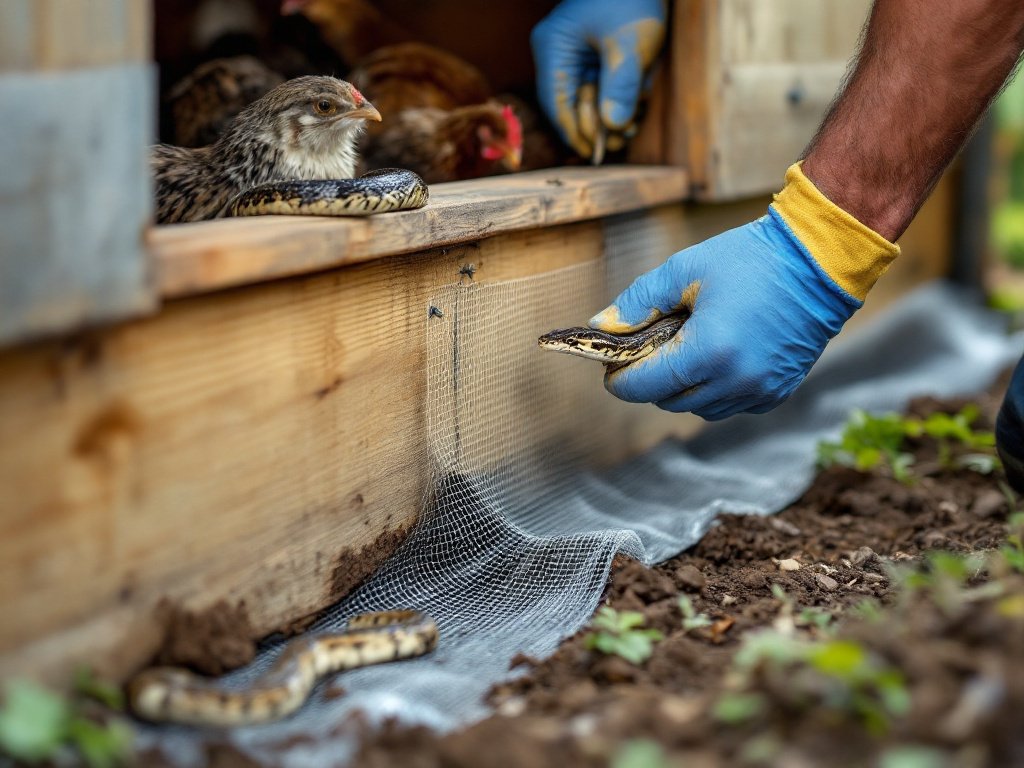
Don’t forget the roof—snakes are excellent climbers if they can get traction. If you need a guide to layout or space calculations for runs and coops, refer to our article on chicken coop space requirements.
Cost Breakdown: What to Expect for Materials and Installation
Snake-proofing isn’t the cheapest upgrade, but it’s a fraction of the cost compared to losing your flock. For an average 8 by 10 foot coop with a 3 foot high run, material estimates look like this (source):
- Hardware cloth mesh: Approximately 108 square feet at $0.80 to $1.20 per square foot, or roughly $90 to $130.
- Framing lumber and screws: Add $70 to $100 depending on quality and if extra supports are needed for sag-prone areas.
- Concrete pavers or slab for base (80 square feet): $5 to $10 per square foot, totaling $400 to $800.
- Total materials estimate: $560 to $1,060.
Labor: A solo DIYer typically spends 4 to 6 hours on installation (or 2–3 hours for two people). Professional labor rates vary by location and project complexity, adding to installation costs.
This is an investment, but one that offers real protection. If you want quality, avoid the “value” mesh or questionable internet deals—look for heavy, fully galvanized cloth from reputable hardware or farm suppliers.
Check our cost to raise chickens guide to budget your full backyard setup and avoid surprise expenses.
Real-World Pain Points and Failure Modes (What Owners Wish They Knew)
Even when using the right mesh, there are common mistakes that lead to snake breaches. According to industry standards and input from chicken owner forums, most failures are due to:
- Shallow burial of mesh—snakes tunnel under even a few inches of exposed edge
- Using chicken wire or mesh larger than ¼ inch—baby snakes slip through quickly
- Loose gates or gaps at latches; insecure seals around doors and pop hatches
- Plastic zip-ties breaking down over time, causing mesh to sag or detach
- Poor quality mesh rusting or sagging, opening up new gaps within a single season
- Ground erosion or settling that creates small gaps beneath the barrier
Owners most often discover failures after losing eggs or seeing shell remnants. Thorough, regular inspections—especially after heavy rains or seasonal ground shifts—are critical.
| Shortcut/Mistake | Risk | Long-Term Result |
|---|---|---|
| Chicken wire or mesh >¼ inch | Allows young or small snakes through | Lost eggs or birds, false sense of security |
| Shallow or no burial of mesh edge | Snakes burrow underneath perimeter | Persistent snake incursions |
| Relying on zip-ties or flimsy fasteners | Mesh loosens or detaches over time | Unseen entry points, frequent repairs |
| Overlooking the roof or upper corners | Snakes climb and enter from above | Random missing eggs or birds with no sign of digging |
Knowledge gaps aren’t the only problem—sometimes, a rushed or cheap installation is tempting. But dozens of owner reports show that every shortcut—especially with mesh size or burial—gets “fixed” by a determined snake.
If choosing a new coop, you can find cold climate build advice in our best chicken coop for cold weather guide, which touches on insulation and hardware cloth tips.

Snake Deterrents: What Works and What Doesn’t
There are dozens of chemical and “natural” products sold as snake repellents—sulfur, cinnamon, garlic, and commercial powder mixes are the most common. However, scientific evidence and owner reviews show these are largely ineffective. Snakes are not put off by sulfur or most home remedies, and some products can actually create messy or unsafe conditions inside your coop or run.
Instead, focus on permanent, physical solutions. A secure, fine mesh barrier with no openings over ¼ inch, a solid base, and tightly sealed seams is proven to keep snakes out—whether they’re climbing, digging, or squeezing. Clearing brush piles, tall grass, and junk near your coop also removes snake hiding spots.
- Do NOT rely solely on sprays, powders, or devices for protection.
- Some wildlife-friendly landscaping or habitat removal methods can reduce snake attraction but can’t replace a properly-built barrier.
- Regular coop cleaning and sanitation help, but only as backup—not a substitute for mesh.
For comprehensive predator strategies, see our how to clean a chicken coop and automatic chicken coop door posts for additional peace of mind.
FAQs About Snake-Proofing Chicken Coops
What’s the ideal hardware cloth mesh size to protect chickens from snakes?
Use only ¼ inch hardware cloth mesh or 1 cm x 1 cm welded wire. Anything larger can let small or juvenile snakes slip through. Chicken wire does not stop snakes.
Should mesh be buried or is surface mounting enough?
Bury mesh at least 4 to 6 inches below ground along the perimeter, or use a concrete or paver base. This blocks snakes (and other burrowing pests) from pushing underneath.
Can I retrofit my existing coop to be snake proof?
Yes. Refit all windows, vents, and run walls with ¼ inch hardware cloth, use screws instead of zip-ties, and address any gaps at doors. Don’t skip securing the lower edge and checking for settling or erosion regularly.
Are chemical snake deterrents or natural remedies effective?
Scientific and owner experience agree—sulfur, cinnamon, garlic, and most commercial repellents do not stop snakes. Only a physical, tightly-installed mesh barrier can reliably protect your chickens from snakes.
How often should I inspect my snake proof coop?
Inspect mesh, base, and gate seals every month, and always after heavy weather. Fine mesh can tear or rust, and new ground gaps might emerge over time.
Conclusion
Protecting your flock with a snake proof coop is a one-time investment that pays off with season-long peace of mind. Remember, shortcuts—especially with mesh size, ground coverage, and gate seals—almost always backfire. Rely on heavy-galvanized ¼ inch mesh, secure it properly, and bury or back the edge. Skip the chemical “deterrents”—the research is clear, and so is the reality reported by keepers across the country. Ready for more tips? Explore reliable flock protection and upgrades on our main site, and always plan ahead to protect chickens from snakes with no weak links.
Got more questions or want hands-on help with flock safety? Explore our guides or reach out to connect with the CoopGearLab community!